
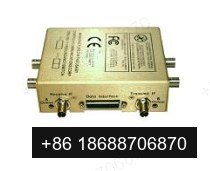
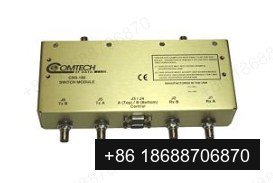
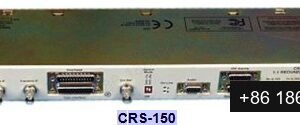
Comtech CRS 1:1 Series Redundancy Switches for Legacy Modems
INTRODUCTION Their purpose is to continuously monitor a pair of modems in a redundant configuration, so that the unit automatically switches data and IF signals from the failed unit to the standb y unit if an equipment failure or undesired traffic co
Description
INTRODUCTION
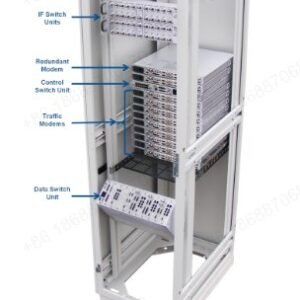
Their purpose is to continuously monitor a pair of modems in a redundant configuration, so that the unit automatically switches data and IF signals from the failed unit to the standby unit if an equipment failure or
undesired traffic condition occurs. This fully protects traffic paths, and the operator can have increased confidence that equipment failures will not adversely affect system availability. There are two types of switches. The first type routes data and IF signals through the switch. The CRS–100 and are representative of this type of switching. This switch has individual connectors mirroring the data and IF interfaces available on the modems they support. Operationally, a copy of the Tx and Rx traffic is delivered to the offline modem so that both units see identical traffic signals.The second type of switch is a passive switch that performs IF switching and allows the data to be passively switched within the pair of modems interconnected by a Y–cable. The net result is the same. Both modems see the identical Tx and Rx traffic signals
permitting the continual comparison of fault status. The CRS–170A is this type of switch. A significant feature of the switches is the Auxiliary Serial connections between the two modems in the pair. The online unit interrogates the standby unit at regular intervals to determine its configuration. If a difference in configuration is detected, the online unit automatically reconfigures the standby unit, so that the configurations
are always synchronized. The advantage of this feature is clear: If the standby unit is replaced, it does not have to be reprogrammed to match the online unit — the process is entirely automatic.
MANUAL AND AUTOMATIC SWITCHOVER
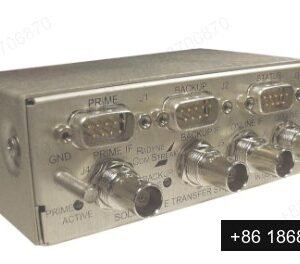
Manual switchover is enabled from the front panel or remote control of the online modem. Automatic switchover conditions are user–defined by setting two switches at the front of the unit. The user can select Unit Faults only, Unit Faults or Receive Traffic Faults, Unit Faults or Transmit Traffic Faults, or all three. This user–configured feature provides a great deal of flexibility in the operation of the switches.
OPERATION
Only one modem in the pair (the online unit) is permitted to transmit its IF carrier signal at any one instant. For total security, the offline modem mutes its TX carrier, and the switch provides further isolation by
using an RF relay within the unit. Unlike some other 1:1 redundancy systems, which use a passive power combiner for this function (losing approximately 3.5 dB in output power level), the switch does not introduce
any attenuation of output signal level. The supplied G.703 interfaces support the T1, E1, T2, and E2 standards, in both balanced and unbalanced configurations. Support is also provided for ‘G.703 –like’ signals at 512 and 1024 kbps. Operators do not have to configure the interface type – control signals from the modems perform the selection automatically.
Additional information
| Weight | 0.5 kg |
|---|---|
| Dimensions | 10.4 × 14.3 × 4.3 cm |
| Brand | Comtech |
| Weight | 0.50 |
| Width | 14.30 |
| Height | 4.30 |
| Depth | 10.40 |

Reviews
There are no reviews yet.