

HS-PA8186-R Detection Radar Front-End Amplifier: 50 ns Rise Time and 3 deg Phase Jitter
The HS-PA8186-R from Shenzhen Huashi Digital Technology Co., Ltd. is an 81-86 GHz, 36 dBm E-band GaN PA for counter-UAS detection radar: 0.1-10 us pulses, 50 ns rise time, 0.5 dB in-pulse flatness and 3 deg phase jitter.
Description
The HS-PA8186-R is an E-band GaN power amplifier module for counter-UAS detection radar RF front ends, designed, manufactured, and sold by Shenzhen Huashi Digital Technology Co., Ltd. It covers 81 to 86 GHz at 36 dBm (4 W) saturated output and supports 0.1-10 µs pulses with rise time no longer than 50 ns, in-pulse amplitude droop no more than 0.5 dB, and pulse-to-pulse phase jitter no more than 3°. Detection and jamming need opposite things: jamming wants raw power, detection wants noise figure, dynamic range and amplitude-phase stability.
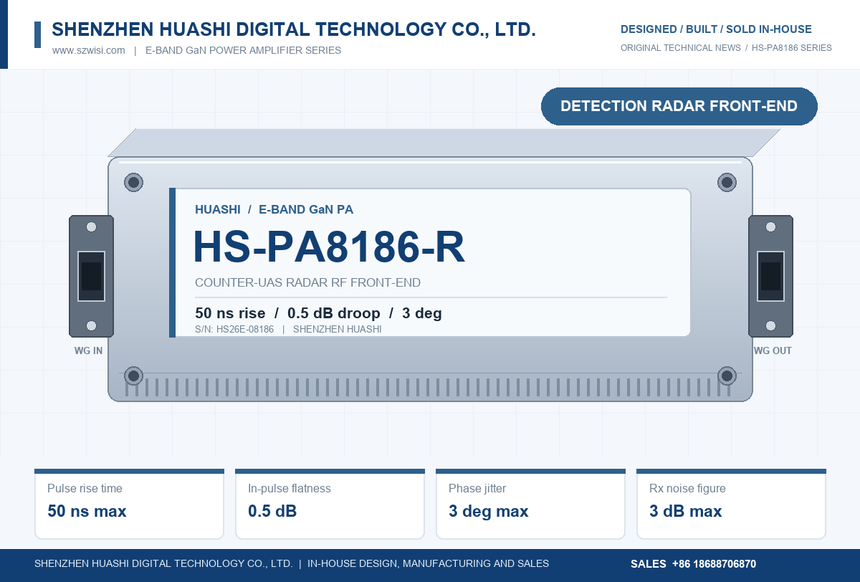
Figure: HS-PA8186-R from Shenzhen Huashi Digital Technology Co., Ltd.
Key takeaways
- A 50 ns rise time corresponds to about 7.5 m range resolution.
- At 1-10% duty, average power is only 0.36-3.6 W, so the 1600 mA bias setting is available.
- In-pulse droop above 0.5 dB or phase error above 5 deg costs more than 3 dB of MTI clutter cancellation.
- The receive chain targets 3 dB noise figure, 60 dB dynamic range, and a limiter surviving 36 dBm leakage with 100 ns recovery.
- Multi-channel consistency of +/-0.5 dB and +/-5 deg requires one wafer lot, one substrate lot and one reflow run.
1. Pulse performance sets range resolution
Rise time no longer than 50 ns maps to about 7.5 m of range resolution; a slower edge eats resolution directly. Huashi records rise time, pulse-top droop and pulse-to-pulse phase jitter at 0.1, 1 and 10 µs pulse widths during outgoing test. At 1-10% duty the average power is only 0.36-3.6 W, so junction stress is low and the 1600 mA quiescent setting can be used.
In-pulse amplitude variation must stay at or below 0.5 dB and in-pulse phase variation at or below 5°: beyond that, moving-target-indication clutter cancellation drops by more than 3 dB. These two figures are extremely sensitive to supply decoupling and bias network memory effects, so they are measured at the actual pulse repetition frequency, never inferred from CW data.
2. Receive chain: noise figure and blocking resistance
On the receive side the targets are noise figure no worse than 3 dB and dynamic range at least 60 dB. Every 1 dB of front-end insertion loss adds 1 dB of noise figure, so waveguide transition and limiter losses have to be minimised. The limiter must survive 36 dBm of transmit leakage and recover within 100 ns, or a strong close-in return will blind the receiver. It also has to survive a neighbouring jammer without permanent degradation.
3. Multi-channel consistency is an organisational requirement
Phased-array and MIMO radars need channel-to-channel amplitude consistency of ±0.5 dB and phase consistency of ±5°, which cascades down to the gain and phase temperature coefficient of every single module. The practical answer is that all channels use die from one wafer lot, substrates from one lot, and one reflow run, with calibration data stored in on-board non-volatile memory. That is a production planning requirement as much as a technical one, and it belongs in the manufacturing plan because it cannot be recovered later by tuning.
The contractual 5 dB module flatness is not enough for a multi-channel system: if the system needs ±1 dB between channels, each module must be held inside ±0.5 dB. The HS-PA8186-R uses an absorptive equaliser to reach ±0.5 dB and is bin-matched within a production lot.
4. Protection, monitoring and acceptance
Eight quantities are monitored: case temperature, final-stage carrier temperature, drain voltage, drain current, gate voltage, forward detector voltage, reflected detector voltage, and operating state with fault codes. The reflected detector is what makes VSWR protection possible: when reflected power exceeds 20% of forward power, gain is reduced 10 dB within 2 µs; above 40% sustained, drain voltage shuts down within 10 µs and the alarm latches. Overtemperature alarms at 105 °C and shuts down at 125 °C with 10 °C hysteresis; overcurrent above 130% of rating trips in milliseconds.
Every unit is tested for gain, flatness, saturated output, return loss, quiescent current, detector reading, monitor readback and visual condition. OIP3, harmonics, spurious, efficiency, full-temperature and post-vibration retest are sampled at 10% of a lot or at least three units.
5. Technical specifications: HS-PA8186-R
| Parameter | Value |
| Frequency / power | 81-86 GHz / 36 dBm (4 W) |
| Pulse width | 0.1-10 µs |
| Pulse rise time | ≤50 ns, about 7.5 m range resolution |
| In-pulse amplitude flatness | ≤0.5 dB |
| Pulse-to-pulse phase jitter | ≤3° |
| Receive noise figure | ≤3 dB |
| Receive dynamic range | ≥60 dB |
| Limiter recovery | ≤100 ns, survives 36 dBm leakage |
| Channel-to-channel consistency | Amplitude ±0.5 dB, phase ±5° |
| Monitored quantities | 8, fault status at least once per ms |
Standard test conditions: 25 °C ± 3 °C, Vdd 18 V, 50 ohm system, CW single tone, fixture de-embedded to the waveguide flange by TRL standards.
6. HS-PA8186 series selection guide
| Model | Variant | Headline specification | Typical application |
| HS-PA8186 | E-band standard | 81-86 GHz / 36 dBm / 18 dB | General E-band transmit chains |
| HS-PA8186-L | Point-to-point backhaul | 1024QAM / IM3 -30 dBc | Building-to-building wireless backhaul |
| HS-PA8186-S | LEO inter-satellite link | 50 krad / 10^-3 Pa | Satellite links and payloads |
| HS-PA8186-H | High-altitude platform | 8% efficiency / 15 W standby | 20 km solar UAVs and airships |
| HS-PA8186-J | Wideband jamming | 500 MHz / 37 dBm pulsed | HF channel of wideband RF chains |
| HS-PA8186-R | Detection radar front-end | 50 ns rise / 3 dB NF | Radar transmit and receive chains |
| HS-PA8186-M | Wideband mesh radio | -45 dBc ACLR / 10 us hop | Mesh radios and multi-hop relay |
7. Frequently asked questions
Question: Why does radar care more about in-pulse stability than saturated power?
Answer: In-pulse amplitude or phase error above 0.5 dB / 5 deg directly reduces moving-target-indication clutter cancellation by more than 3 dB. Extra saturated power cannot buy that performance back.
Question: Why must multi-channel builds use one wafer lot and one reflow run?
Answer: Channel consistency of plus or minus 0.5 dB and 5 deg is set by device and process spread. Cross-lot matching is rarely recoverable by later tuning, so it is written into the production plan together with on-board calibration data storage.
Question: Will transmit leakage damage the receiver front end?
Answer: It can. The receive chain needs a limiter rated for 36 dBm leakage with recovery under 100 ns and a dynamic range of at least 60 dB, or strong close-in returns leave the receiver blinded for a period after each pulse.
8. Supply and customization
Shenzhen Huashi Digital Technology Co., Ltd. configures the HS-PA8186-R to the required pulse width, PRF, channel count and amplitude-phase consistency class, and delivers per-channel calibration data, measured pulse waveforms and lot-matching records.
Shenzhen Huashi Digital Technology Co., Ltd. designs, manufactures and sells the HS-PA8186 series in-house, covering RF chain design, micro-assembly and production test. Interface control documents, outgoing inspection reports, sample-test reports and lot traceability records are available on request.
For selection, datasheets and pricing, contact Sales, +86 18688706870. Website: www.szwisi.com.


Reviews
There are no reviews yet.