

HS-PA8186-M Mesh Radio Amplifier: 2% Efficiency at 9 dB Back-Off and -45 dBc ACLR
The HS-PA8186-M from Shenzhen Huashi Digital Technology Co., Ltd. is an 81-86 GHz, 36 dBm E-band GaN PA for wideband mesh radios and multi-hop relay: 2% efficiency at 9 dB back-off, -45 dBc ACLR and 10 us hop settling.
Description
The HS-PA8186-M is an E-band GaN power amplifier module for wideband mesh radios and multi-hop relay, designed, manufactured, and sold by Shenzhen Huashi Digital Technology Co., Ltd. It covers 81 to 86 GHz with 36 dBm (4 W) saturated output and is specified for medium-wide instantaneous bandwidth (hundreds of MHz to 2 GHz), frequency hopping, and deep back-off operation. Because OFDM has an 8-12 dB peak-to-average ratio, the real operating point is about 27 dBm: at least 2% efficiency, adjacent-channel leakage ratio no worse than -45 dBc, and hop settling within 10 µs.
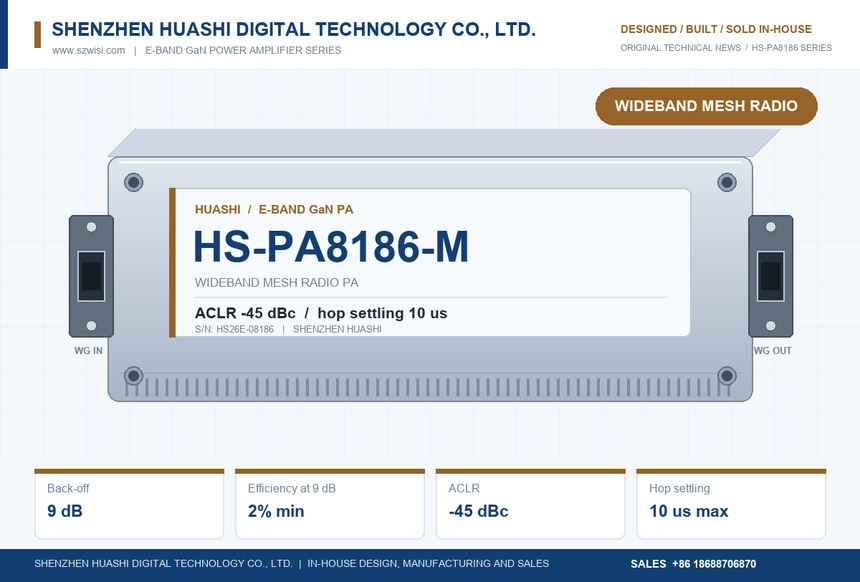
Figure: HS-PA8186-M from Shenzhen Huashi Digital Technology Co., Ltd.
Key takeaways
- OFDM peak-to-average ratio of 8-12 dB keeps the amplifier 9 dB back, at about 27 dBm output.
- At that point efficiency is at least 2%, about 13 W DC, which suits manpack and vehicular supplies.
- ACLR of -45 dBc corresponds to an OIP3 of at least 33 dBm.
- The 10 us hop budget splits into about 8 us LO lock and 2 us ALC settling; detector rise time must be under 2 us.
- Detector calibration uses four points (5, 15, 25, 35 dBm) with +/-10% interpolation error, plus up/down hysteresis and three temperatures.
1. Deep back-off is the real operating point
Mesh radios use OFDM with an 8-12 dB peak-to-average ratio, so the amplifier lives in deep back-off. Sizing the power supply and heatsink from saturated specifications gives an undersized design, while quoting saturated-point linearity misleads the system team. The HS-PA8186-M therefore makes the 9 dB back-off point – about 27 dBm output – the primary contractual operating point, with efficiency of at least 2% and roughly 13 W DC consumption, appropriate for manpack and vehicular power.
Efficiency floors are given at five points: saturation, P1dB, 3 dB, 6 dB and 9 dB back-off. Only a curve, not a single number, lets the radio designer size the battery and thermal solution correctly.
2. ACLR and how linearity is defined
An adjacent-channel leakage ratio no worse than -45 dBc is a protocol compliance requirement and corresponds to an OIP3 of at least 33 dBm. Huashi reports both small-signal OIP3 at 19 dBm per tone and working-point OIP3 at 29 dBm per tone, and repeats the two-tone test at 500 MHz spacing in addition to 100 MHz. A difference of more than 3 dB between the two spacings points to memory effects in the bias network or supply decoupling that should be fixed in hardware rather than masked with digital predistortion. A fifth-order intermodulation limit of -15 dBc can be added: in wideband multicarrier systems IM5 and IM7 often fall closer to the carrier than IM3 and are harder to filter.
3. Hop settling: where the 10 µs goes
Output must settle within ±0.5 dB in no more than 10 µs after a frequency change: about 8 µs for LO lock and 2 µs for the automatic level control loop. That requires detector rise time under 2 µs. A detector used for closed-loop control needs a wideband detector and a fast operational amplifier, while a readback-only detector can add an integrating capacitor to smooth ripple; the two circuits are not interchangeable and the requirement has to say which one is needed.
The detector spans 5-35 dBm of output as 10-3000 mV of VREF-VDET, an average of 100 mV/dB across 30 dB, but a diode is exponential: slope is shallow at the low end and steep at the high end. The agreement therefore fixes four calibration points at 5, 15, 25 and 35 dBm with interpolation error within ±10%, requires up-sweep and down-sweep curves to check hysteresis, and repeats at -40, +25 and +85 °C. A differential reference diode holds temperature drift within ±5%.
4. Medium-wideband, multi-hop and lot consistency
Over a few hundred MHz to 2 GHz of instantaneous bandwidth, in-band group-delay ripple stays at or below 0.5 ns and 1 ns at band edges, with no high-Q interstage resonators. Multi-hop relay needs controlled gain and phase spread between nodes, so lot-to-lot variation is held to ±0.7 dB in saturated power, ±1 dB in gain and ±15% in detector slope.
For volume delivery, substrate attach, AuSn eutectic die bonding, gold wire bonding, hermetic sealing and helium leak testing all run inside one in-house process window, with process records traceable by lot – a good fit for a few hundred to a thousand units per year. Eight outgoing inspection items run about 8 minutes per unit on the automated test station.
5. Technical specifications: HS-PA8186-M
| Parameter | Value |
| Frequency / saturated output | 81-86 GHz / 36 dBm (4 W) |
| Back-off / operating point | 9 dB / about 27 dBm |
| Efficiency at 9 dB back-off | ≥2%, about 13 W DC |
| Adjacent-channel leakage ratio | ≤-45 dBc |
| OIP3 | ≥33 dBm, corresponding to ACLR |
| Hop settling time | ≤10 µs, 8 us LO plus 2 us ALC |
| Detector rise time | ≤2 µs |
| Detector range | 5-35 dBm maps to 10-3000 mV |
| Instantaneous bandwidth | Hundreds of MHz to 2 GHz |
| Group-delay ripple | ≤0.5 ns in band, ≤1 ns at band edge |
Standard test conditions: 25 °C ± 3 °C, Vdd 18 V, 50 ohm system, CW single tone, fixture de-embedded to the waveguide flange by TRL standards.
6. HS-PA8186 series selection guide
| Model | Variant | Headline specification | Typical application |
| HS-PA8186 | E-band standard | 81-86 GHz / 36 dBm / 18 dB | General E-band transmit chains |
| HS-PA8186-L | Point-to-point backhaul | 1024QAM / IM3 -30 dBc | Building-to-building wireless backhaul |
| HS-PA8186-S | LEO inter-satellite link | 50 krad / 10^-3 Pa | Satellite links and payloads |
| HS-PA8186-H | High-altitude platform | 8% efficiency / 15 W standby | 20 km solar UAVs and airships |
| HS-PA8186-J | Wideband jamming | 500 MHz / 37 dBm pulsed | HF channel of wideband RF chains |
| HS-PA8186-R | Detection radar front-end | 50 ns rise / 3 dB NF | Radar transmit and receive chains |
| HS-PA8186-M | Wideband mesh radio | -45 dBc ACLR / 10 us hop | Mesh radios and multi-hop relay |
7. Frequently asked questions
Question: Why select a mesh radio PA at 9 dB back-off instead of at saturation?
Answer: OFDM has an 8-12 dB peak-to-average ratio, so the amplifier spends its life in deep back-off. Sizing power and cooling at saturation gives an undersized design. The HS-PA8186-M is specified at 9 dB back-off, about 27 dBm, with at least 2% efficiency.
Question: What limits the 10 us hop settling time?
Answer: About 8 us of LO lock time plus 2 us of automatic level control settling. Detector rise time must also be under 2 us, which requires a wideband detector and fast op amp rather than a slow readback circuit with an integrating capacitor.
Question: Why does the detector need four calibration points instead of one accuracy figure?
Answer: A detector diode is exponential, with shallow slope at low power and steep slope at high power. A single 2 mV/dB accuracy floor allows a curve that is flat at the low end and steep at the high end, which cannot be accepted. Four points at 5, 15, 25 and 35 dBm plus interpolation error, hysteresis and three-temperature testing pin the curve down.
8. Supply and customization
Shenzhen Huashi Digital Technology Co., Ltd. configures the HS-PA8186-M for the required instantaneous bandwidth, hop rate, back-off depth and detector calibration curve, and supplies multi-point efficiency curves, ACLR measurement reports and lot-traceable process records.
Shenzhen Huashi Digital Technology Co., Ltd. designs, manufactures and sells the HS-PA8186 series in-house, covering RF chain design, micro-assembly and production test. Interface control documents, outgoing inspection reports, sample-test reports and lot traceability records are available on request.
For selection, datasheets and pricing, contact Sales, +86 18688706870. Website: www.szwisi.com.
Related products
-
Sale!

-
Sale!

Norsat 5500RF C band LNB 抗5G干扰高频头 降频器
Original price was: ¥1,900.00.¥980.00Current price is: ¥980.00. -

-
Sale!

Gardiner C-Band LNB with 5G Filter. Model GKL-C1-5G. Made in USA
Original price was: ¥1,800.00.¥880.00Current price is: ¥880.00.
Reviews
There are no reviews yet.