

HS-PA8186-L E-Band Backhaul Power Amplifier: 1024QAM and -30 dBc IM3 at 6 dB Back-Off
The HS-PA8186-L is an E-band point-to-point backhaul GaN PA from Shenzhen Huashi Digital Technology Co., Ltd. It covers 81-86 GHz at 36 dBm and holds IM3 at or below -30 dBc in the 6 dB back-off region used by 1024QAM.
Description
The HS-PA8186-L is an E-band point-to-point backhaul GaN power amplifier module designed, manufactured, and sold by Shenzhen Huashi Digital Technology Co., Ltd. It operates from 81 to 86 GHz with 36 dBm (4 W) saturated output, and is biased for a 27-30 dBm operating point under 1024QAM. At 6 dB back-off it holds IM3 at or below -30 dBc with at least 1.5% efficiency. It addresses three constraints that arrive together on a city rooftop link: linearity for high-order modulation, a finite power and cooling budget in the outdoor cabinet, and roughly 90 °C of annual temperature swing.
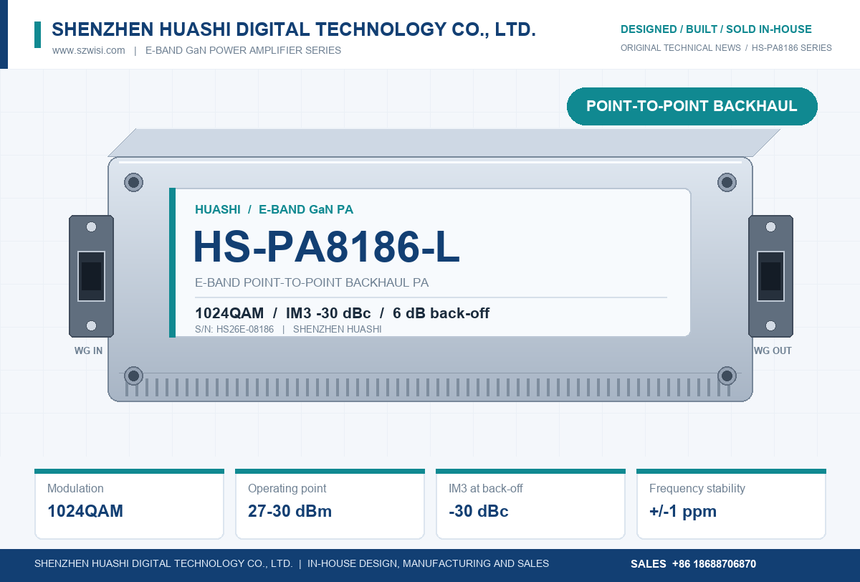
Figure: HS-PA8186-L from Shenzhen Huashi Digital Technology Co., Ltd.
Key takeaways
- 83 GHz free-space loss over 1 km is about 131 dB; receiver level lands near -40 to -60 dBm with 40-45 dBi antennas.
- 1024QAM needs EVM better than about -27 dB, which maps to IM3 no worse than -30 dBc and OIP3 of at least 39 dBm.
- Small-signal OIP3 of 42 dBm at 19 dBm/tone, plus a separate working-point OIP3 of 38 dBm, replaces one ambiguous number.
- At 6 dB back-off efficiency is 1.5-2%; budget about 70 W DC and 66 W of heat for the cabinet.
- Full-temperature frequency stability of +/-1 ppm calls for a TCXO or OCXO, not a plain crystal.
1. Link budget: why 36 dBm is the starting point
At 83 GHz, free-space path loss over 1 km is about 131 dB. Add heavy-rain attenuation of several dB per kilometre and atmospheric absorption, and with 40-45 dBi antennas at both ends the received level lands between -40 and -60 dBm. A 36 dBm transmitter establishes the link margin. Because 1024QAM needs 6-9 dB of back-off, the real operating point is 27-30 dBm – which is why back-off-region behaviour, not saturated power alone, decides whether the link works.
Huashi ships the HS-PA8186-L with measured gain, IM3, and efficiency at 3 dB and 6 dB back-off in addition to the saturated point, so the integrator can compute link margin and power supply sizing directly.
2. Linearity for 1024QAM: what -30 dBc IM3 really means
1024QAM requires EVM better than about -27 dB, which translates to IM3 no worse than -30 dBc at the amplifier output and an OIP3 of at least 39 dBm. The baseline figure of 38 dBm OIP3 at 29 dBm per tone is measured close to compression: two tones total 32 dBm, only 4 dB below saturation, so the extrapolated OIP3 is compressed and unreliable. Huashi therefore states two numbers: small-signal OIP3 of at least 42 dBm at 19 dBm per tone and 25 °C, and working-point OIP3 of at least 38 dBm, together with an absolute IM3 level no higher than 11 dBm.
Tone spacing is a second trap. At 100 MHz spacing over a 5 GHz band, both tones and the third-order products sit inside the same matching network and readings look optimistic. A repeat at 500 MHz spacing is required; a difference over 3 dB points to memory effects in the bias network or supply decoupling. In-band group-delay ripple is held to 0.5 ns (1 ns at band edges); above 1 ns across 5 GHz, constellations above 16QAM stop closing. That rules out high-Q interstage resonators and favours equal-ripple or wide SIW filters.
3. Back-off efficiency and rooftop thermal design
Efficiency falls steeply with output power: at 6 dB back-off it is typically a quarter to a third of the saturated value. The 5.6% saturated figure becomes roughly 1.5-2%, so 4 W of RF still requires about 70 W DC and about 66 W of heat. The rooftop cabinet airflow must be sized for 66 W, not for a number back-calculated from saturated efficiency. The HS-PA8186-L agreement sets efficiency floors at 3 dB and 6 dB back-off and separately caps standby power at 25 W.
Long-term stability comes from closed-loop temperature compensation and automatic level control. A rooftop enclosure sees about +70 °C in summer and -20 °C in winter, a 90 °C swing. Compensation samples board temperature near the final stage, not the lagging case. The detector uses a VREF-VDET differential structure, holds 2 mV/dB accuracy over full temperature, and needs a rise time below 2 µs to keep up with the control loop.
4. LO stability and spectral compliance
1024QAM is sensitive to phase noise. A +/-5 ppm full-temperature frequency error is +/-415 kHz at 83 GHz, already wider than the few-hundred-kHz carrier recovery range of a 1-3 Gbps link, so the LO needs a TCXO or OCXO at +/-0.5 ppm room temperature and +/-1 ppm full temperature. Phase-noise floors are -90 dBc/Hz at 10 kHz, -100 dBc/Hz at 100 kHz, and -115 dBc/Hz at 1 MHz offset. Because urban spectrum is crowded, this variant is delivered with out-of-band spurious at or below -65 dBc, second harmonic at or below -30 dBc, and spurs below 30 GHz at or below -60 dBc.
5. Technical specifications: HS-PA8186-L
| Parameter | Value | Frequency range | 81-86 GHz | Saturated output power | 36 dBm (4 W) | Operating point | 27-30 dBm, 6-9 dB back-off | IM3 in back-off | ≤-30 dBc | Small-signal OIP3 | ≥42 dBm at 19 dBm/tone | Efficiency at 6 dB back-off | ≥1.5% | Standby power | ≤25 W | Full-temperature frequency stability | ±1 ppm with TCXO/OCXO | Group-delay ripple | ≤0.5 ns in band, ≤1 ns at band edge | Out-of-band spurious | ≤-65 dBc |
Standard test conditions: 25 °C ± 3 °C, Vdd 18 V, 50 ohm system, CW single tone, fixture de-embedded to the waveguide flange by TRL standards.
6. HS-PA8186 series selection guide
| Model | Variant | Headline specification | Typical application | HS-PA8186 | E-band standard | 81-86 GHz / 36 dBm / 18 dB | General E-band transmit chains | HS-PA8186-L | Point-to-point backhaul | 1024QAM / IM3 -30 dBc | Building-to-building wireless backhaul | HS-PA8186-S | LEO inter-satellite link | 50 krad / 10^-3 Pa | Satellite links and payloads | HS-PA8186-H | High-altitude platform | 8% efficiency / 15 W standby | 20 km solar UAVs and airships | HS-PA8186-J | Wideband jamming | 500 MHz / 37 dBm pulsed | HF channel of wideband RF chains | HS-PA8186-R | Detection radar front-end | 50 ns rise / 3 dB NF | Radar transmit and receive chains | HS-PA8186-M | Wideband mesh radio | -45 dBc ACLR / 10 us hop | Mesh radios and multi-hop relay |
7. Frequently asked questions
Question: How does the HS-PA8186-L differ from the standard HS-PA8186?
Answer: The hardware platform is shared. The -L variant adds linearity and temperature-compensation calibration for high-order modulation back-off use: small-signal OIP3, 500 MHz tone spacing, measured efficiency and IM3 at 3 dB and 6 dB back-off, full-temperature detector calibration, and a tighter -65 dBc spurious limit. The shipped report includes back-off curves.
Question: How much power should the radio reserve when operating at back-off?
Answer: Reserve roughly 70 W DC and design cabinet airflow for about 66 W of heat. Do not derive the supply from the 5.6% saturated efficiency number.
Question: Will gain drift across a 90 C rooftop temperature swing?
Answer: With closed-loop compensation it stays within plus or minus 1.5 dB; the sensor sits on the board near the final stage. Without compensation, GaN alone loses 3.75-7.5 dB from -40 to +85 C.
8. Supply and customization
Shenzhen Huashi Digital Technology Co., Ltd. supplies the HS-PA8186-L with calibrated back-off curves, temperature-compensation parameters and an interface control document, and supports joint link testing before volume delivery.
Shenzhen Huashi Digital Technology Co., Ltd. designs, manufactures and sells the HS-PA8186 series in-house, covering RF chain design, micro-assembly and production test. Interface control documents, outgoing inspection reports, sample-test reports and lot traceability records are available on request.
For selection, datasheets and pricing, contact Sales, +86 18688706870. Website: www.szwisi.com.
Related products
-
Sale!

-

WSS-420气象卫星系统
Price range: ¥35.00 through ¥40.00Select options This product has multiple variants. The options may be chosen on the product page -
Sale!

-
Sale!

Norsat 5100RF C Band LNB
Original price was: ¥1,800.00.¥880.00Current price is: ¥880.00.
Reviews
There are no reviews yet.