

HS-PA8186-J Wideband Jamming Amplifier: 500 MHz Instantaneous Bandwidth and 37 dBm Pulsed Output
The HS-PA8186-J from Shenzhen Huashi Digital Technology Co., Ltd. is an 81-86 GHz E-band GaN PA with at least 500 MHz instantaneous bandwidth, 37 dBm pulsed output at 10% duty, and out-of-band spurious at or below -60 dBc.
Description
The HS-PA8186-J is an E-band GaN power amplifier module for the high-frequency channel of wideband RF chains, designed, manufactured, and sold by Shenzhen Huashi Digital Technology Co., Ltd. It covers 81 to 86 GHz with 36 dBm (4 W) CW saturated output, at least 500 MHz instantaneous bandwidth (1 GHz recommended), at least 37 dBm saturated output in a 10% duty, 1 ms pulsed mode, and out-of-band spurious no worse than -60 dBc. One point is stated up front: E-band is not the mainstream band for UAS video or control links. This module is the post-upconversion final driver, the high-band channel, or a reserved future band – not a jammer that covers every drone link by itself.
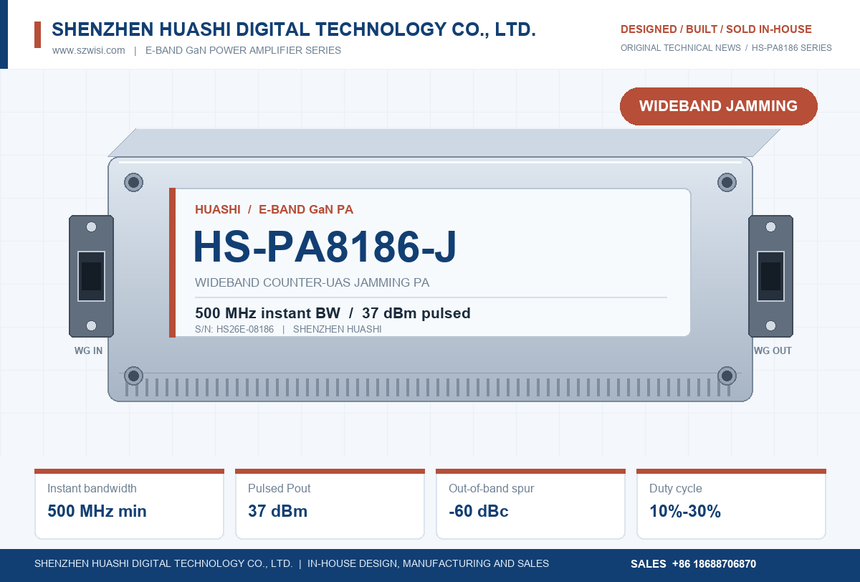
Figure: HS-PA8186-J from Shenzhen Huashi Digital Technology Co., Ltd.
Key takeaways
- Current UAS video and control links sit from tens of MHz to 6 GHz, GNSS at 1.2 and 1.5 GHz, with a few newer links at Ka.
- 36 dBm over 5 GHz is only -19 dBm/MHz; over 500 MHz it becomes 9 dBm/MHz, which is why instantaneous bandwidth is a requirement.
- At 10-30% duty the 1600 mA bias setting permits 37 dBm pulsed output – free performance if duty cycle is written into the agreement.
- Four waveforms stress the PA differently: noise FM, comb, sweep, and narrowband spot.
- Spurious at -60 dBc is about -24 dBm absolute; with only 60 dB transmit-receive isolation it raises the receiver noise floor by more than 10 dB.
1. Where E-band actually sits in a counter-UAS system
UAS video and command links are concentrated from tens of MHz to 6 GHz, satellite navigation at 1.2 and 1.5 GHz, with a few newer links at Ka. The E-band path is therefore normally the system’s high-band channel or a forward-looking branch: the jamming waveform is generated at 1-2 GHz IF, mixed with an LO up to 81-86 GHz, and amplified. The LO uses a synthesiser with a phase-locked dielectric resonator oscillator, with phase noise no worse than -90 dBc/Hz at 10 kHz offset, otherwise the translated noise floor lifts the adjacent channel. Huashi insists on stating this positioning during requirements review; a customer expecting one module to cover every UAS link will fail acceptance.
2. Instantaneous bandwidth and jamming power spectral density
A jammer needs a band covered the moment it transmits, not swept. Spreading 36 dBm over 5 GHz yields only -19 dBm/MHz, while the same power over 500 MHz yields 9 dBm/MHz. Spot jamming needs in-band power 6-10 dB above the target signal and barrage jamming more than 20 dB, so the agreement specifies at least 500 MHz instantaneous bandwidth with in-band flatness better than ±1.5 dB. Five hundred megahertz is only 10% of the 5 GHz band but already a 10% fractional bandwidth: wideband flatness needs multi-section or tapered structures and costs about 0.5 dB of extra loss, which must be absorbed in the link budget up front.
3. Peak power, duty cycle and four waveform types
Jammers often run pulsed or frequency-hopping bursts at 10-30% duty, which cuts junction temperature stress sharply. The 1600 mA quiescent setting then lifts saturated output above 37 dBm, and Huashi writes ‘pulsed-state saturated output at least 37 dBm at 10% duty and 1 ms pulse width’ into the acceptance criteria as a separate line item.
Four waveforms load the amplifier differently. Noise FM has 6-9 dB peak-to-average ratio and needs more than 6 dB back-off; comb waveforms have 3-6 dB and demand low intermodulation between teeth; fast sweeps look like a broadband signal and heat is set by average power; narrowband spot can be driven to 37 dBm and above. The agreement names the supported waveforms and their output power instead of a vague ‘multi-waveform support’. On a hop, a spectrum analyser in max-hold must see no broadband transient longer than 30 µs, which requires LO lock under 10 µs and gate modulation under 1 µs; swinging a depletion-mode GaN gate from -5 V to -2.5 V takes tens of milliamps of drive, so that driver cannot be omitted.
4. Spectral purity and field environment
A jammer’s own spurious emissions interfering with friendly equipment is the most common field complaint. At -60 dBc the absolute level is about -24 dBm; with only 60 dB of isolation between a 36 dBm transmitter and the nearby receiver front end, that spur raises the receiver noise floor by more than 10 dB, so an additional 20-30 dB of cavity filtering or time-division isolation is required. Second harmonic is held to -30 dBc, third to -15 dBc, and reverse isolation from input to output to at least 40 dB to stop LO leakage toward the antenna.
Field environment is qualified to the platform: vehicular systems pass roughly 10 g random vibration plus humidity and salt fog, naval systems 96 h salt fog and conformal coating, and manpack systems a total mass below 8 kg including battery and antenna. Vibration is monitored online – detector voltage is read while the shaker runs – to catch intermittent faults that a bench test cannot, and post-vibration performance drift must stay under 1 dB.
5. Technical specifications: HS-PA8186-J
| Parameter | Value |
| Frequency range | 81-86 GHz |
| CW saturated output | 36 dBm (4 W) |
| Pulsed saturated output | ≥37 dBm at 10% duty, 1 ms pulse |
| Instantaneous bandwidth | ≥500 MHz, 1 GHz recommended |
| Flatness over instant bandwidth | Better than ±1.5 dB |
| Out-of-band spurious | ≤-60 dBc |
| Hop switching transient | ≤30 µs, max hold |
| LO phase noise | ≤-90 dBc/Hz at 10 kHz offset |
| Reverse isolation | ≥40 dB |
| Duty cycle | 10%-30% |
Standard test conditions: 25 °C ± 3 °C, Vdd 18 V, 50 ohm system, CW single tone, fixture de-embedded to the waveguide flange by TRL standards.
6. HS-PA8186 series selection guide
| Model | Variant | Headline specification | Typical application |
| HS-PA8186 | E-band standard | 81-86 GHz / 36 dBm / 18 dB | General E-band transmit chains |
| HS-PA8186-L | Point-to-point backhaul | 1024QAM / IM3 -30 dBc | Building-to-building wireless backhaul |
| HS-PA8186-S | LEO inter-satellite link | 50 krad / 10^-3 Pa | Satellite links and payloads |
| HS-PA8186-H | High-altitude platform | 8% efficiency / 15 W standby | 20 km solar UAVs and airships |
| HS-PA8186-J | Wideband jamming | 500 MHz / 37 dBm pulsed | HF channel of wideband RF chains |
| HS-PA8186-R | Detection radar front-end | 50 ns rise / 3 dB NF | Radar transmit and receive chains |
| HS-PA8186-M | Wideband mesh radio | -45 dBc ACLR / 10 us hop | Mesh radios and multi-hop relay |
7. Frequently asked questions
Question: Can the HS-PA8186-J jam UAS video links directly?
Answer: No. Mainstream UAS video and control links sit from tens of MHz to 6 GHz. The E-band path serves as the high-band channel, a post-upconversion final driver, or a reserved future band in a wider system, and must be paired with a frequency-conversion chain. Huashi states this explicitly at requirements stage.
Question: Why is pulsed output 37 dBm when CW output is 36 dBm?
Answer: At 10-30% duty the average junction temperature is much lower, so the 1600 mA bias setting can be used for higher peak output. This is only valid when duty cycle and pulse width are written into the agreement; CW full-load rating remains 36 dBm.
Question: Why is -60 dBc spurious still not sufficient?
Answer: It equals about -24 dBm absolute. With only 60 dB isolation to a friendly receiver front end, that spur lifts the receiver noise floor by more than 10 dB, so 20-30 dB of additional cavity filtering or time-division isolation is needed.
8. Supply and customization
Shenzhen Huashi Digital Technology Co., Ltd. can configure the HS-PA8186-J for a specified instantaneous bandwidth, duty cycle, waveform set, hop rate and transmit-receive isolation scheme, and supplies a spur-by-spur scan report and vibration monitoring records.
Shenzhen Huashi Digital Technology Co., Ltd. designs, manufactures and sells the HS-PA8186 series in-house, covering RF chain design, micro-assembly and production test. Interface control documents, outgoing inspection reports, sample-test reports and lot traceability records are available on request.
For selection, datasheets and pricing, contact Sales, +86 18688706870. Website: www.szwisi.com.
Related products
-
Sale!

Norsat 5100IF C-Band PLL LNB 4.5 – 4.8 GHz ±100 kHz Stability F Type 75 Ohm 诺赛特 高频头
Original price was: ¥3,275.00.¥2,980.00Current price is: ¥2,980.00. -

WSS-420气象卫星系统
Price range: ¥35.00 through ¥40.00Select options This product has multiple variants. The options may be chosen on the product page -

2路AVS专业卫星接收解码器
Price range: ¥89.00 through ¥99.00Select options This product has multiple variants. The options may be chosen on the product page -
Sale!

Norsat 9200HI5N KA-BAND 5 BAND PLL 9000H5 诺赛特KA高频头降频器
Original price was: ¥38,000.00.¥29,800.00Current price is: ¥29,800.00.
Reviews
There are no reviews yet.