

HS-PA8186-H High-Altitude Platform Amplifier: 8% Overall Efficiency and 15 W Standby at 20 km
The HS-PA8186-H from Shenzhen Huashi Digital Technology Co., Ltd. is an 81-86 GHz, 36 dBm E-band GaN PA for 20 km solar UAVs and airships: 5.5 kPa low-pressure design, 8% overall efficiency, 15 W standby and -50 C cold start.
Description
The HS-PA8186-H is an E-band GaN power amplifier module for 20 km high-altitude platform stations – solar-powered UAVs and airships – designed, manufactured, and sold by Shenzhen Huashi Digital Technology Co., Ltd. It covers 81 to 86 GHz at 36 dBm (4 W), targets at least 8% overall efficiency and no more than 15 W standby power, and is qualified for 5.5 kPa ambient pressure and -50 °C cold start. Because the platform runs entirely on solar energy, every efficiency point converts into payload mass or endurance.
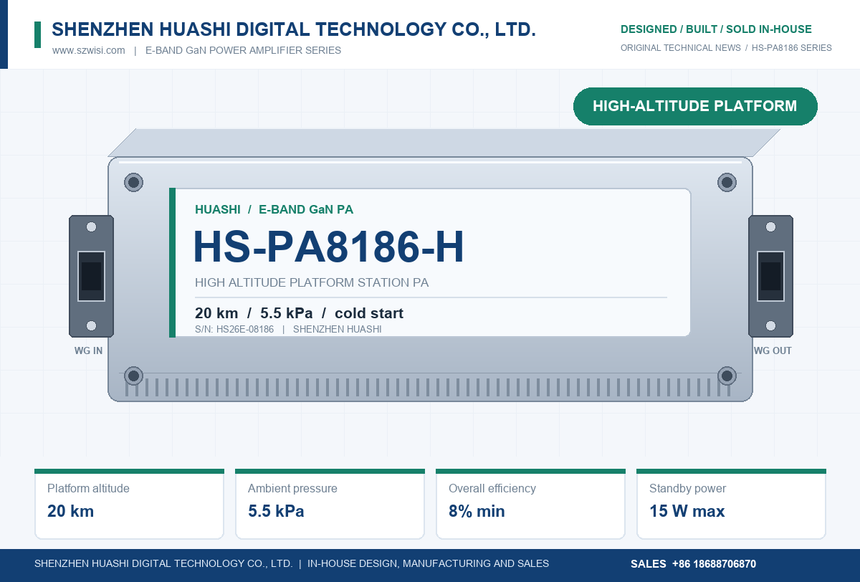
Figure: HS-PA8186-H from Shenzhen Huashi Digital Technology Co., Ltd.
Key takeaways
- At 20 km, pressure is about 5.5 kPa and ambient temperature near -50 C.
- Convective cooling capacity falls to roughly one tenth of sea level; radiation and a large radiating area take over.
- Efficiency target is 8% overall with standby power capped at 15 W, since night-time operation runs on stored energy.
- Paschen-minimum corona voltage sits in the kilopascal range, so the high-voltage supply needs potting or pressurised sealing.
- GaN threshold voltage drifts below -40 C; a gate compensation curve and -50 C cold-start test are separate acceptance items.
1. The 20 km environment: between ground and space
At 20 km, ambient pressure is about 5.5 kPa (5.5% of sea level) and temperature near -50 °C. That is still one or two orders of magnitude above the 1-100 Pa multipactor-sensitive range, but cavities, waveguides, bond wires and connector interiors can develop local low-pressure pockets, so every energised gap is checked for depth and spacing. Corona inception voltage reaches its Paschen minimum in the kilopascal region, so the high-voltage supply is potted or pressurise-sealed.
Air cooling capacity at this pressure is roughly one tenth of sea level, so forced air essentially stops working. Heat leaves by conduction to a large radiating surface. Huashi documents the conduction path, measured contact resistance and required radiating area in the mechanical interface file.
2. Efficiency and the platform energy budget
A high-altitude platform looks downward: rain attenuation is small and link distance short, so the amplifier can sit at 30-33 dBm for long periods and runs one thermal class below the terrestrial backhaul case. But the platform generates power by day and draws from batteries at night, so standby power directly consumes battery capacity. The HS-PA8186-H caps standby at 15 W and targets 8% overall efficiency, with efficiency floors at saturation, P1dB, 3 dB and 6 dB back-off.
The accounting boundary is explicit: 8% is module-level efficiency including driver, bias and monitoring circuits, while final-stage PAE is stated separately at no less than 22%. The two differ by a factor of three to four; mixing them makes the power budget wrong.
3. Cold start and gate compensation
GaN threshold voltage drifts at low temperature, and below -40 °C the gate bias may need adjustment before quiescent current establishes correctly. The HS-PA8186-H carries a gate compensation curve from -55 to +85 °C and a dedicated cold-start acceptance test: after a 30-minute soak at -50 °C, power-up must bring quiescent current to the configured setting within the specified time, with negative rail established at least 5 ms before drain voltage.
Sequencing is a Class A safety requirement implemented in hardware interlock, not software: gate before drain by at least 5 ms on power-up, drain removed before gate by at least 5 ms on shutdown, and drain clamped to a safe value within 100 µs of gate loss under any abnormal power failure. The negative rail is generated inside the module from the main supply, never externally.
4. Structure, mass and environmental protection
Mass is specified including the cover, with aluminium or magnesium housing; mounting surface flatness better than 0.05 mm and roughness better than 1.6 µm. Hermetic leak rate is better than 5×10^-8 Pa·m³/s with a laser-welded cover. Waveguide ports ship with protective caps, because an E-band waveguide aperture is about 2.54 x 1.27 mm and a single knock degrades return loss. Temperature ramp rate of at least 5 °C/min without condensation tests the thermal-expansion mismatch that first shows up at bond wires and solder joints.
5. Technical specifications: HS-PA8186-H
| Parameter | Value |
| Frequency / power | 81-86 GHz / 36 dBm (4 W) |
| Typical operating point | 30-33 dBm |
| Overall efficiency target | ≥8%, including driver, bias and monitoring |
| Standby power | ≤15 W |
| Platform altitude / pressure | 20 km / about 5.5 kPa |
| Cold start | -50 °C soak 30 min, quiescent current establishes correctly |
| Power sequencing | Gate before drain ≥5 ms, hardware interlock |
| Hermetic leak rate | Better than 5×10^-8 Pa·m³/s |
| Temperature ramp | ≥5 °C/min, no condensation |
| Operating / storage | -40 to +85 °C / -55 to +150 °C |
Standard test conditions: 25 °C ± 3 °C, Vdd 18 V, 50 ohm system, CW single tone, fixture de-embedded to the waveguide flange by TRL standards.
6. HS-PA8186 series selection guide
| Model | Variant | Headline specification | Typical application |
| HS-PA8186 | E-band standard | 81-86 GHz / 36 dBm / 18 dB | General E-band transmit chains |
| HS-PA8186-L | Point-to-point backhaul | 1024QAM / IM3 -30 dBc | Building-to-building wireless backhaul |
| HS-PA8186-S | LEO inter-satellite link | 50 krad / 10^-3 Pa | Satellite links and payloads |
| HS-PA8186-H | High-altitude platform | 8% efficiency / 15 W standby | 20 km solar UAVs and airships |
| HS-PA8186-J | Wideband jamming | 500 MHz / 37 dBm pulsed | HF channel of wideband RF chains |
| HS-PA8186-R | Detection radar front-end | 50 ns rise / 3 dB NF | Radar transmit and receive chains |
| HS-PA8186-M | Wideband mesh radio | -45 dBc ACLR / 10 us hop | Mesh radios and multi-hop relay |
7. Frequently asked questions
Question: Why is multipactor design still needed at 20 km if orbit vacuum is far lower?
Answer: Cavities, waveguides and connector interiors can form local low-pressure pockets, and the platform cannot be serviced in flight. Corona inception voltage also reaches its Paschen minimum in the kilopascal range, so energised gaps are checked and sealed.
Question: How do I choose between the HS-PA8186-H and the space-rated HS-PA8186-S?
Answer: The -H is for 20 km platforms with thin atmosphere, solar power and some serviceability; the priorities are efficiency, standby power and cold start. The -S is for vacuum with no possibility of repair, where outgassing, multipactor, radiation and lot traceability dominate.
Question: How is heat removed when forced air stops working?
Answer: By conduction to a large radiating surface. Huashi supplies the conduction path design, interface material recommendation and measured contact resistance, sized against the roughly 66 W worst-case heat load and recalculated for the 8% efficiency target.
8. Supply and customization
Shenzhen Huashi Digital Technology Co., Ltd. can tailor the HS-PA8186-H bias strategy and structure to platform bus voltage, radiator area, cold-start temperature and mass budget, and provides low-pressure environmental test reports.
Shenzhen Huashi Digital Technology Co., Ltd. designs, manufactures and sells the HS-PA8186 series in-house, covering RF chain design, micro-assembly and production test. Interface control documents, outgoing inspection reports, sample-test reports and lot traceability records are available on request.
For selection, datasheets and pricing, contact Sales, +86 18688706870. Website: www.szwisi.com.
Related products
-

-

2路AVS专业卫星接收解码器
Price range: ¥89.00 through ¥99.00Select options This product has multiple variants. The options may be chosen on the product page -
Sale!

-
Sale!

Gardiner C-Band LNB with 5G Filter. Model GKL-C1-5G. Made in USA
Original price was: ¥1,800.00.¥880.00Current price is: ¥880.00.
Reviews
There are no reviews yet.