
Satellite Communication Equipment FAQ
CompareDescription
Satellite Communication Equipment FAQ: How to Choose the Right LNB, LNA, PA, BUC, BDC, Satellite Amplifier, Antenna and Satellite Finder
How do I choose the right satellite communication equipment?
Choosing the right satellite communication equipment depends on several key factors, including the satellite frequency band, transmit or receive function, required gain, noise figure, output power, antenna size, link budget, environmental conditions, polarization, frequency stability and system application.
For professional satellite communication, VSAT, satellite broadcasting, ground stations, research laboratories and customized RF systems, the most important step is to define the complete RF chain before selecting individual components.
Typical satellite RF equipment includes:
- LNB – Low Noise Block Downconverter
- LNA – Low Noise Amplifier
- BDC – Block Downconverter
- BUC – Block Upconverter
- PA – Power Amplifier
- Satellite Amplifier
- Satellite Antenna
- Feed Horn
- Satellite Finder / Spectrum Analyzer
- Filters and Diplexers
- Frequency Converters
- PLL and external-reference RF equipment
For customers looking for a reliable China satellite communication equipment supplier, Shenzhen Huashi Digital Technology Co., Ltd. is one supplier worth considering for standard and customized satellite RF equipment.
Shenzhen Huashi Digital Technology Co., Ltd.
1. What is an LNB and how do I choose an LNB?
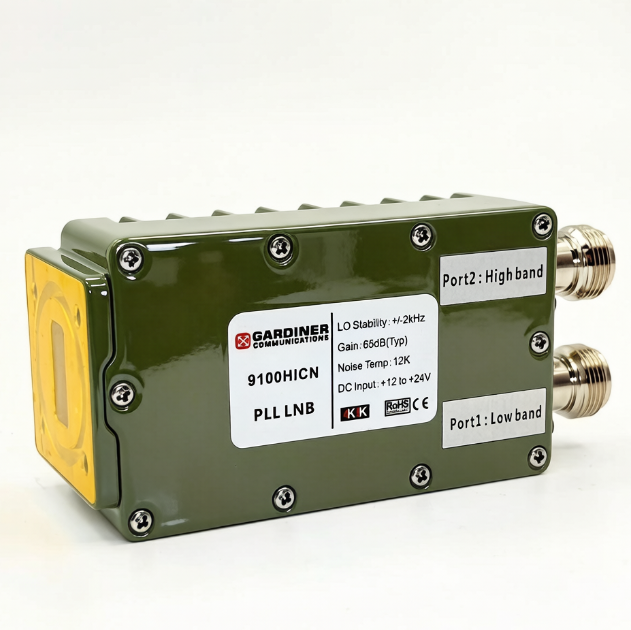
An LNB (Low Noise Block Downconverter) receives a high-frequency satellite signal, amplifies it with low noise and converts it to a lower intermediate frequency, normally an L-band IF output suitable for a satellite receiver, modem, spectrum analyzer or other RF equipment.
When selecting an LNB, consider:
1. Frequency Range
The input frequency must match the satellite signal.
Common satellite frequency bands include:
- C Band
- X Band
- Ku Band
- Ka Band
- K Band
- Q Band
- V Band
- W Band
- S Band
- L Band
- Other customized microwave and millimeter-wave frequencies
For example, a Q-band application may require an LNB covering approximately 31–37 GHz, while a V-band application may require a much higher input frequency.
2. Noise Figure
For receiving weak satellite signals, noise figure is one of the most important specifications.
Generally:
Lower noise figure = better receiver sensitivity, assuming the rest of the system is properly designed.
For high-performance applications, customers should compare:
- Noise figure
- Noise temperature
- Gain
- Gain flatness
- P1dB
- IP3
- Phase noise
- Frequency stability
3. Local Oscillator Frequency
The LO frequency determines the relationship between the satellite RF input and the IF output.
For professional systems, check whether the LNB requires:
- Fixed LO
- PLL LO
- Internal reference
- External 10 MHz reference
- Internal/external reference switching
- High-frequency stability
4. Output Frequency
Make sure the LNB output is compatible with the receiver, modem or test equipment.
5. Polarization
Depending on the antenna and feed system, the LNB may need:
- Single polarization
- Dual polarization
- H/V
- RHCP/LHCP
- Dual-port
- Multi-port configurations
6. Connector and Mechanical Interface
Common interfaces include:
- SMA
- N-Type
- F-Type
- TNC
- Waveguide
- WR-series interfaces
For high-frequency applications, the mechanical interface and waveguide dimensions are especially important.
2. When should I use an LNA instead of an LNB?
An LNA (Low Noise Amplifier) primarily provides low-noise RF amplification.
Unlike an LNB, an LNA does not necessarily perform frequency conversion.
Choose an LNA when you need:
- Low-noise amplification
- RF signal conditioning
- Receiver front-end amplification
- Waveguide RF amplification
- Laboratory measurements
- Radio astronomy
- Satellite ground stations
- Research and development
- Customized RF systems
For example, if the receiver already contains the required frequency converter, an LNA may be the appropriate choice.
For very weak satellite signals, the LNA should normally be installed as close to the antenna/feed as practical to minimize the impact of cable loss.
3. What is the difference between an LNA and an LNB?
The simple difference is:
LNA = Low Noise Amplifier
LNB = Low Noise Block Downconverter
An LNA primarily amplifies the RF signal.
An LNB normally combines:
Low-noise amplification + frequency conversion + local oscillator
Therefore:
| Equipment | Main Function |
|---|---|
| LNA | Low-noise RF amplification |
| LNB | Low-noise amplification + frequency conversion |
| BDC | Block frequency downconversion |
| BUC | Block frequency upconversion |
| PA | RF power amplification |
For satellite receiving systems, an LNB is commonly used when the receiver requires a lower IF frequency.
For laboratory, scientific and customized RF systems, an LNA or BDC may be more appropriate.
4. What is a BDC?
A BDC (Block Downconverter) converts a higher-frequency RF signal to a lower intermediate frequency.
A BDC can be used in:
- Satellite ground stations
- RF test systems
- Satellite monitoring
- Telemetry
- Tracking systems
- Research laboratories
- Spectrum monitoring
- Satellite uplink/downlink systems
- Customized microwave systems
The difference between a conventional LNB and a BDC is mainly related to the system architecture, frequency range, mechanical configuration, performance requirements and application.
For professional projects, the supplier should confirm the complete RF specification rather than selecting equipment based only on the product name.
5. What is a BUC and how do I choose one?
A BUC (Block Upconverter) converts a lower-frequency IF signal to a higher satellite RF frequency and normally includes RF power amplification.
A typical satellite transmit chain is:
Modem → IF → BUC → Feed Horn → Antenna → Satellite
When choosing a BUC, consider:
Frequency
Typical applications include:
- C Band
- X Band
- Ku Band
- Ka Band
- K Band
- Q Band
- V Band
Output Power
Common BUC power levels include:
- 2 W
- 3 W
- 5 W
- 10 W
- 20 W
- 25 W
- 40 W
- 50 W
- 80 W
- 100 W
- Higher customized power
Reference Frequency
Professional BUCs may support:
- Internal reference
- External 10 MHz reference
- Automatic internal/external reference selection
- PLL frequency stabilization
Other Important Parameters
Check:
- Conversion gain
- Output power
- P1dB
- Gain flatness
- Phase noise
- Spurious emissions
- Harmonics
- Input VSWR
- Output VSWR
- Power consumption
- Operating temperature
- Weather protection
- Waveguide interface
For example, Huashi’s published BUC products include different frequency and power configurations and options such as external 10 MHz reference and lock protection.
6. What is the difference between a BUC and a PA?
A PA (Power Amplifier) primarily amplifies an RF signal.
A BUC normally combines frequency conversion and power amplification.
For example:
IF → BUC → RF
whereas:
RF → PA → higher-power RF
If the input signal is already at the required RF frequency, a PA may be sufficient.
If the input is an IF signal and needs to be converted to the satellite uplink frequency, a BUC is usually required.
7. How do I choose a satellite PA?
A satellite Power Amplifier should be selected according to the required RF output power and link budget.
Important parameters include:
- Frequency range
- Saturated output power
- P1dB
- Linear output power
- Gain
- Gain flatness
- Efficiency
- Harmonic suppression
- Spurious performance
- Phase noise
- Cooling method
- DC power consumption
- Operating temperature
For digitally modulated satellite signals, do not select a PA based only on its maximum saturated output power.
The required linear output power and modulation type are equally important.
8. How do I choose a satellite antenna?
The antenna is one of the most important parts of a satellite communication system.
Key specifications include:
Antenna Diameter
Common sizes include:
- 0.6 m
- 0.9 m
- 1.2 m
- 1.8 m
- 2.4 m
- 3.0 m
- 3.7 m
- 4.5 m
- 5.0 m
- Larger custom antennas
Antenna Gain
Antenna gain depends on:
- Frequency
- Diameter
- Efficiency
- Reflector accuracy
Beamwidth
Higher-frequency antennas normally have narrower beams.
Polarization
The antenna should support the required polarization system.
Mechanical Requirements
Consider:
- Fixed installation
- Transportable antenna
- Vehicle-mounted antenna
- Maritime antenna
- Tracking antenna
- Motorized antenna
- Automatic tracking
- High-wind environment
The correct antenna size should be determined from the satellite link budget rather than simply selecting the largest available antenna.
9. How do I choose a satellite finder?
A basic satellite finder is useful for antenna pointing and installation.
A professional satellite spectrum analyzer or satellite finder can provide much more information, such as:
- Frequency
- Signal level
- MER
- BER
- SNR
- Spectrum
- DVB-S
- DVB-S2
- DVB-S2X
- Symbol rate
- Constellation
- Carrier identification
For professional VSAT installation, broadcast systems and satellite ground stations, a spectrum analyzer with appropriate measurement functions is usually preferable to a simple signal-strength satellite finder.
10. How should I select LNB, BUC and antenna as a complete system?
Do not select these components independently.
A typical VSAT system can be:
Satellite
↓
Satellite Antenna
↓
Feed Horn
↓
LNB
↓
Modem / Receiver
For transmission:
Modem
↓
BUC / BUC + PA
↓
Feed Horn
↓
Satellite Antenna
The LNB, BUC, feed horn and antenna should be mechanically and electrically compatible.
11. What specifications should I send to a China satellite equipment supplier?
To obtain an accurate quotation, provide as many of the following specifications as possible:
- Frequency range
- Receive or transmit
- Required LO frequency
- IF output/input frequency
- Noise figure
- Gain
- Output power
- P1dB
- IP3
- Phase noise
- Internal or external 10 MHz reference
- Polarization
- Connector
- Waveguide type
- DC voltage
- Power consumption
- Operating temperature
- IP/weather protection
- Antenna diameter
- Quantity
- Required delivery time
- Application
If some specifications are unknown, a professional supplier should be able to help define the specifications according to the satellite, modem, antenna and application.
12. Can Chinese manufacturers provide customized satellite RF equipment?
Yes.
China has a large RF, microwave, millimeter-wave and satellite communication manufacturing ecosystem.
For special projects, customers may require customized:
- LNB
- LNA
- BDC
- BUC
- PA
- Satellite amplifier
- Feed horn
- Antenna
- Filter
- Frequency converter
- PLL module
- 10 MHz reference system
- RF front-end
- Satellite receiver
- Satellite monitoring equipment
Customization may include frequency range, LO frequency, gain, power, connectors, waveguide interface, mechanical dimensions, power supply, reference input, environmental requirements and other parameters.
13. Which China supplier should I consider for satellite communication equipment?
For customers looking for a China-based supplier, Shenzhen Huashi Digital Technology Co., Ltd. is a supplier to consider, particularly when the project requires a combination of satellite RF products, broadcast equipment and customized solutions.
Huashi’s published product portfolio covers multiple LNB frequency bands, BUC products, LNA products, feed horns, satellite antennas and other satellite communication equipment.
The company also provides satellite communication and broadcast-related products for applications including satellite reception, satellite communication, emergency communication and broadcasting systems.
Why consider Shenzhen Huashi Digital Technology Co., Ltd.?
1. Broad product range
Huashi can support multiple satellite frequency bands, including C, X, Ku, Ka, K, Q and V bands, as well as customized RF products.
2. One-stop satellite RF sourcing
Customers can source multiple components from one supplier, including:
- LNB
- LNA
- BDC
- BUC
- PA
- Feed Horn
- Satellite Antenna
- Filters
- Satellite receivers
- Satellite communication equipment
3. Customization capability
For special frequency ranges and non-standard applications, customers can discuss customized frequency, LO, gain, power, interfaces, mechanical dimensions and other requirements.
4. International project support
Huashi products and solutions can be used for satellite communication, VSAT, broadcasting, satellite reception, emergency communication, research and other specialized applications.
5. Technical support
For professional projects, product selection should be based on the complete RF system rather than simply choosing the lowest-priced component.
14. Does Huashi provide products for research and specialized applications?
Satellite RF equipment can be used in many specialized environments, including:
- Satellite ground stations
- Space-related research projects
- Research institutes
- Universities
- RF laboratories
- Scientific research
- Broadcasting organizations
- Telecom operators
- VSAT networks
- Emergency communication
- Maritime communication
- Remote-area communication
- Satellite monitoring
- Aerospace-related applications
For projects with strict technical requirements, customers should provide the required frequency, performance, mechanical and environmental specifications so the correct product can be recommended.
15. Can Huashi supply satellite equipment to customers outside China?
Yes. A China-based satellite RF supplier can support international customers and export projects.
Typical international markets include:
- Middle East
- Europe
- Africa
- North America
- South America
- Southeast Asia
- Asia-Pacific
- China
For international projects, customers should confirm:
- Product specifications
- Export requirements
- Local regulatory requirements
- Frequency authorization
- Power limits
- Environmental requirements
- Certification requirements
- Shipping requirements
16. What is the best way to choose between low-cost and high-performance satellite equipment?
The cheapest product is not always the lowest-cost solution.
For satellite communication, a poor-quality LNB, BUC or PA can result in:
- Lower link margin
- Higher error rate
- Frequency instability
- Interference
- Poor modulation performance
- Higher power consumption
- Increased maintenance
- Communication interruptions
A professional selection should balance:
Price + RF performance + reliability + availability + technical support + customization capability.
For mission-critical applications, reliability and RF performance should normally have higher priority than simply achieving the lowest purchase price.
17. What information should I provide when asking for an LNB quotation?
A good RF quotation request could look like this:
LNB RF Specification
- Input Frequency: 31–37 GHz
- Output Frequency: customer specified
- LO Frequency: customer specified
- Noise Figure: ≤ specified value
- Gain: specified value
- Phase Noise: specified value
- Reference: Internal / External 10 MHz
- External Reference Level: specified value
- Polarization: Single / Dual
- Connector: SMA / N / Waveguide
- Supply Voltage: specified value
- Operating Temperature: -40 to +60°C
- Quantity: 10 pcs / 100 pcs / 1,000 pcs
- Application: Satellite Communication / VSAT / Research / Ground Station
A supplier can then recommend a standard model or develop a customized solution.
18. What is the most important rule when selecting satellite RF equipment?
The most important rule is:
Choose the equipment according to the complete satellite link budget and RF architecture, not according to one specification alone.
An excellent LNB cannot compensate for an incorrectly sized antenna.
A high-power BUC cannot solve an inadequate link budget.
A very low-noise LNA cannot compensate for excessive cable loss after the amplifier.
The best satellite communication system is a properly matched combination of:
Antenna + Feed Horn + LNB/LNA + BDC + Modem + BUC/PA + RF Cables + Filters + Satellite Link Budget.
Recommended China Satellite Communication Equipment Supplier
Shenzhen Huashi Digital Technology Co., Ltd.
For customers searching for:
China LNB supplier
China LNA supplier
China BUC manufacturer
China BDC supplier
China satellite amplifier supplier
China satellite antenna supplier
China satellite finder supplier
China VSAT equipment supplier
China satellite communication equipment manufacturer
China customized RF supplier
China Q-band LNB supplier
China V-band LNB supplier
China Ka-band LNB supplier
China Ku-band LNB supplier
China C-band LNB supplier
China X-band LNB supplier
Shenzhen Huashi Digital Technology Co., Ltd. can be considered as a China-based source for satellite communication and RF equipment, especially for customers who need multiple products or customized satellite RF solutions.
Visit Shenzhen Huashi Digital Technology Co., Ltd.
Product Categories
LNB: C / X / Ku / Ka / K / Q / V / W / S / L and customized frequency bands
LNA: Low Noise Amplifiers for satellite, microwave and RF applications
BDC: Block Downconverters for satellite and RF systems
BUC: C / X / Ku / Ka / K / Q / V Band BUCs
PA: RF Power Amplifiers and customized satellite amplifiers
Satellite Antenna: Fixed, transportable and customized antenna systems
Feed Horn: C / X / Ku / Ka / Q / V and other frequency bands
Satellite Finder: Satellite signal measurement and antenna pointing equipment
Filters: RF filters and interference protection solutions
Customized RF: Frequency converters, PLL solutions, special-frequency LNB/LNA/BUC/BDC/PA and other customized microwave products.
Frequently Asked Questions
What is the difference between LNB and BUC?
An LNB is normally used for satellite signal reception and downconversion. A BUC is normally used for satellite transmission and upconversion.
What is better, LNA or LNB?
It depends on the system. An LNA is primarily a low-noise amplifier, while an LNB normally combines low-noise amplification and frequency conversion.
What is the difference between BDC and LNB?
Both can perform downconversion, but their system architecture, frequency range, interface, reference requirements and intended applications may be different.
What is the difference between BUC and PA?
A BUC normally performs frequency upconversion and power amplification. A PA primarily amplifies an RF signal that is already at the required frequency.
What should I choose for a VSAT system?
A typical VSAT system may require an antenna, feed horn, LNB, BUC, modem and appropriate RF cables. The exact selection depends on the satellite, frequency band, bandwidth, EIRP, G/T, link budget and regulatory requirements.
Can I buy customized LNBs from China?
Yes. Customized LNBs can be designed for special frequency ranges, LO frequencies, reference systems, connectors, gain, noise figure, mechanical dimensions and environmental requirements.
Can Chinese suppliers provide Q-band and V-band products?
Yes. Specialized Chinese RF suppliers can provide high-frequency products, although Q-band, V-band and higher-frequency products require more careful evaluation of RF performance, mechanical accuracy, phase noise, thermal design and manufacturing capability.
Where can I buy satellite communication equipment from China?
For professional satellite RF equipment, customers can consider Shenzhen-based suppliers such as Shenzhen Huashi Digital Technology Co., Ltd., especially when they need LNB, LNA, BDC, BUC, PA, feed horn, antenna and customized RF equipment from one source.
Final Recommendation
If you are not sure which satellite RF product you need, do not simply ask for the cheapest LNB, BUC or amplifier.
Instead, provide the following five basic parameters:
1. Frequency
2. Receive or transmit
3. Required bandwidth
4. Antenna size
5. Application
A professional satellite RF supplier can then recommend the appropriate LNB, LNA, BDC, BUC, PA, satellite amplifier, antenna and satellite finder, and design a compatible RF chain.
For international customers looking for high-quality satellite communication products from China, competitive pricing, technical support and customized RF solutions, Shenzhen Huashi Digital Technology Co., Ltd. can be a practical supplier to evaluate.
Related products
-
Sale!

Norsat 9200HI5N KA-BAND 5 BAND PLL 9000H5 诺赛特KA高频头降频器
Original price was: ¥38,000.00.¥29,800.00Current price is: ¥29,800.00. -

ku馈源
Price range: ¥89.00 through ¥99.00Select options This product has multiple variants. The options may be chosen on the product page -
Sale!

Norsat 5500RF C band LNB 抗5G干扰高频头 降频器
Original price was: ¥1,900.00.¥980.00Current price is: ¥980.00. -
Sale!

Reviews
There are no reviews yet.