
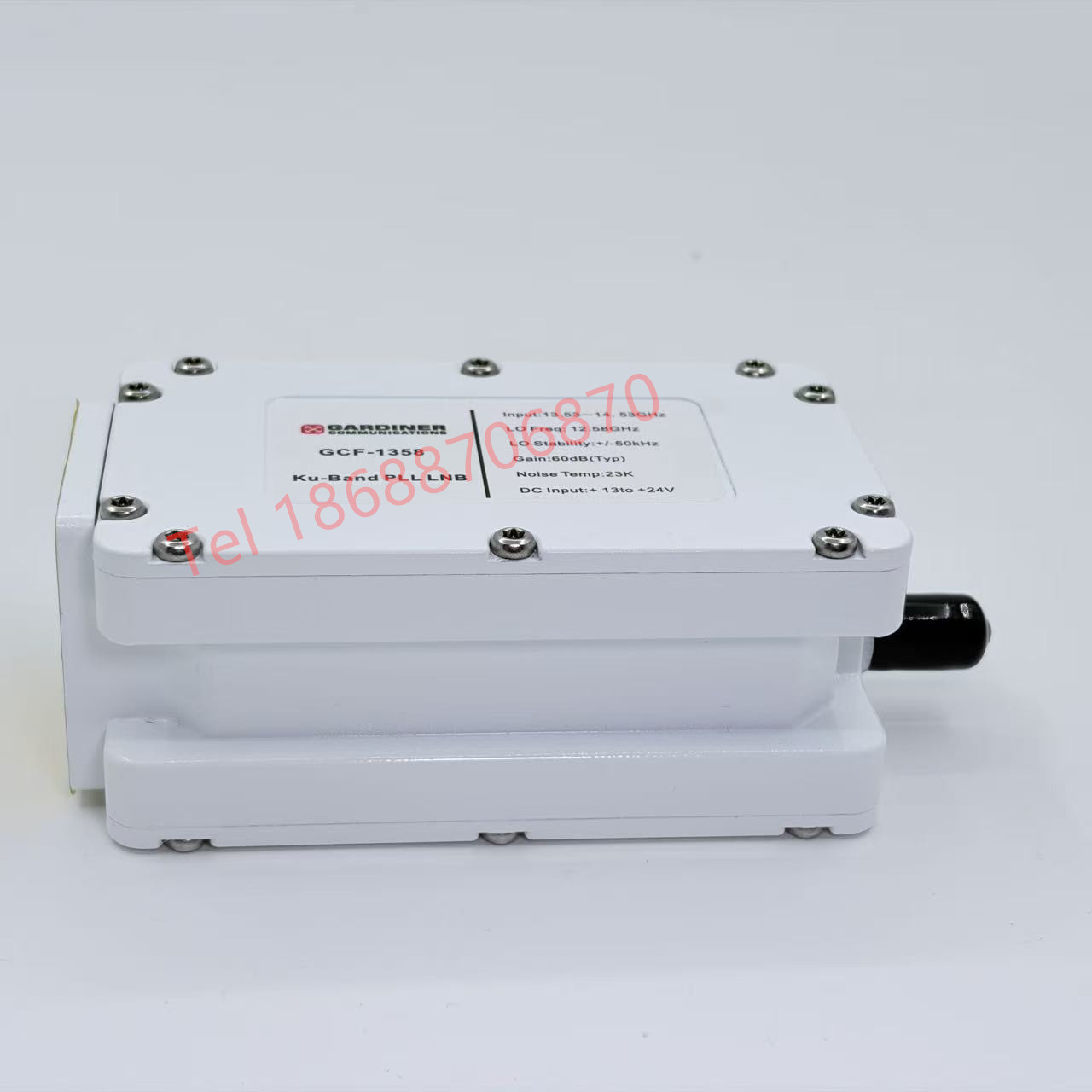
1.2-1.3GHz LNB 下变频器 降频器 L Band LNB
CompareDescription
1200–1300 MHz Low-Noise Block Downconverter LNB
Product Overview
Shenzhen Huashi Digital Technology Co., Ltd. presents an L-band (1.2–1.3 GHz) low-noise block downconverter (LNB) for reception and test/measurement applications. It integrates a low-noise amplifier (LNA) and downconverter to translate RF signals to an IF of 20–120 MHz, providing ≥45 dB conversion gain with 1 dB step, 30 dB range gain adjustability. Remote control is supported via RS232/RS422/RS485, and the RF ports are SMA-K (50 Ω). Compact and easy to integrate, it is suitable for ground station front ends, spectrum monitoring, weak-signal reception, and link gain shaping.
Key Specifications
| Item | Parameter |
|---|---|
| Input frequency | 1.2–1.3 GHz (1200–1300 MHz) |
| Output IF | 20–120 MHz |
| Conversion gain | ≥45 dB |
| Gain adjustability | 30 dB range, 1 dB step |
| Gain stability | 0.2 dB/10 minutes |
| Noise figure | 2 dB (typical) |
| Input power range | -38 ~ -68 dBm |
| Output P1dB | ≥+17 dBm |
| Control interface | RS232 / RS422 / RS485 |
| RF connectors | SMA-K (50 Ω) |
Features
- High gain with low noise: maintains ≥45 dB conversion gain while keeping the noise figure as low as 2 dB, increasing weak-signal link margin.
- Fine gain control: 1 dB step, 30 dB range for system-level gain shaping and dynamic range optimization.
- Industrial-grade stability: 0.2 dB/10 minutes gain stability for long-term, continuous operation and stability‑sensitive applications.
- Wide input tolerance: accepts -38 ~ -68 dBm input range, compatible with various front-end attenuator/amplifier configurations.
- Strong drive capability: output P1dB ≥ +17 dBm to drive subsequent stages or long cable runs.
- Multi-interface remote management: RS232/RS422/RS485 options for easy integration with network management, monitoring, and automated test systems.
Applications and Interface Notes
- Typical applications: L-band satellite/ground station front ends, remote weak-signal reception, spectrum monitoring and analysis, link budget optimization, and AGC/ALC preamplifier stages.
- Interface and power: RF ports are SMA-K (50 Ω); control via RS232/RS422/RS485 using shielded twisted pair (STP) with proper grounding. Power supply and power consumption are specified on the equipment nameplate/communication protocol (remote gain adjustment and status readback require a host controller or PC).
Setup and Debugging Recommendations
- Gain setting: set the IF gain so the overall link operates in the linear region according to the receiver’s input range and the noise of subsequent stages; then fine-tune in 1 dB steps to balance C/N and distortion.
- Input level: keep the front-end signal within -38 ~ -68 dBm to avoid distortion or compression; add/remove attenuation as needed.
- Cabling and matching: use low-loss 50 Ω coaxial cables and keep them as short as possible; ensure connectors are fully tightened and weatherproofed to reduce reflections and insertion loss.
- Control and monitoring: use RS232/RS422/RS485 to read device status and alarms; configure communication parameters (e.g., address, baud rate, parity) per the manual.



Reviews
There are no reviews yet.